Welcome to Swinging By

These are the places of interest that I've been to and I would like to share them with you. I hope you find them interesting too.

Sunday, February 5, 2012

Thaipusam

On Tuesday 7th February, Malaysian Indians who are Hindus will celebrate Thaipusam. In Kuala Lumpur, a procession with a silver chariot bearing the statue of Lord Muruga will move from a temple near Chinatown to the Batu Caves accompanied by crowds of devotees.
En route to Batu Caves, the procession will stop at the Hindu temples where devotees offer trays of thanksgiving to the priests that accompany the chariot. The priests bless these offerings. Thousands of coconuts are also smashed on the road as a form of thanksgiving.
This symbolizes the destruction of the ego and in its place is humility. The devotee who smashes the coconut is casting off his ego and humbling himself in deference to Lord Muruga.

Many devotes fast and pray, practicing abstinence and celibacy, in the month leading up to Thaipusam. They carry offerings and climb the 272 steps to the temple in the main cave to thank Lord Muruga for wishes granted. Most pray for family blessings, such as good examination results for their children and good health while some women pray to be blessed with children.

Some devotees carry the Kavadi, a wooden arch with two pots of or honey at its end, decorated with peacock feathers. There are also some who pierce their bodies with hooks and skewers and carry elaborate kavadi.
This is done in fulfillment of vows made when they prayed for Lord Muruga to grant their wishes. The kavadi bearers are usually in a trance. The women usually carry pots of milk to the shrine up in the caves.
Devotees climb up the steps to the caves’ main temple. There is an impressive 140 ft statue of Lord Muruga at the base of the Batu Caves.
When they reach the top, they lay down their kavadi. The milk and honey offerings are poured on the statue of the deity as an act of thanksgiving. The priest chants as the kavadi bearers remove the hooks and skewers from their bodies. The wounds are treated with hot ash and there is no blood. The devotees do not feel pain as they emerge from their trance.

Sunday, January 29, 2012

An Unusual Dragon

This is a dragon that is erected outside one of the malls in Kuala Lumpur. What is unusual about it is that it is constructed out of 75,000 sticks of "lidi" or the stem of the coconut leaf. It is 35 meters long.
The lidi is usually stripped from the leaf and is made into brooms to sweep the house compound or a wet bathroom. It is stiff at one end and soft and pliable at the other which makes it an effective broom. Unfortunately, there are not many lidi brooms available today.

When I was young, we used to strip the lidi from old coconut leaves that had fallen to the ground and we would make our own brooms. My grandmother taught us how to do it. After collecting sufficient lidi we would bind the stiff ends together with a straw string, ( kiam chow )and viola! We had a broom which we put to good use sweeping away the fallen leaves in her house compound. Some people would attach the lidi to a long piece of wood so that they could sweep better without having to bend as they swept.
This unusual dragon entered the Malaysia Book of Records as the longest hand-made dragon using "lidi". At night the inside of the dragon is lit up with LED lights while the eyes are yellow light bulbs that glow, making the dragon a beautiful sight to behold at night.

Monday, January 23, 2012

Lunar New Year Mall Decor

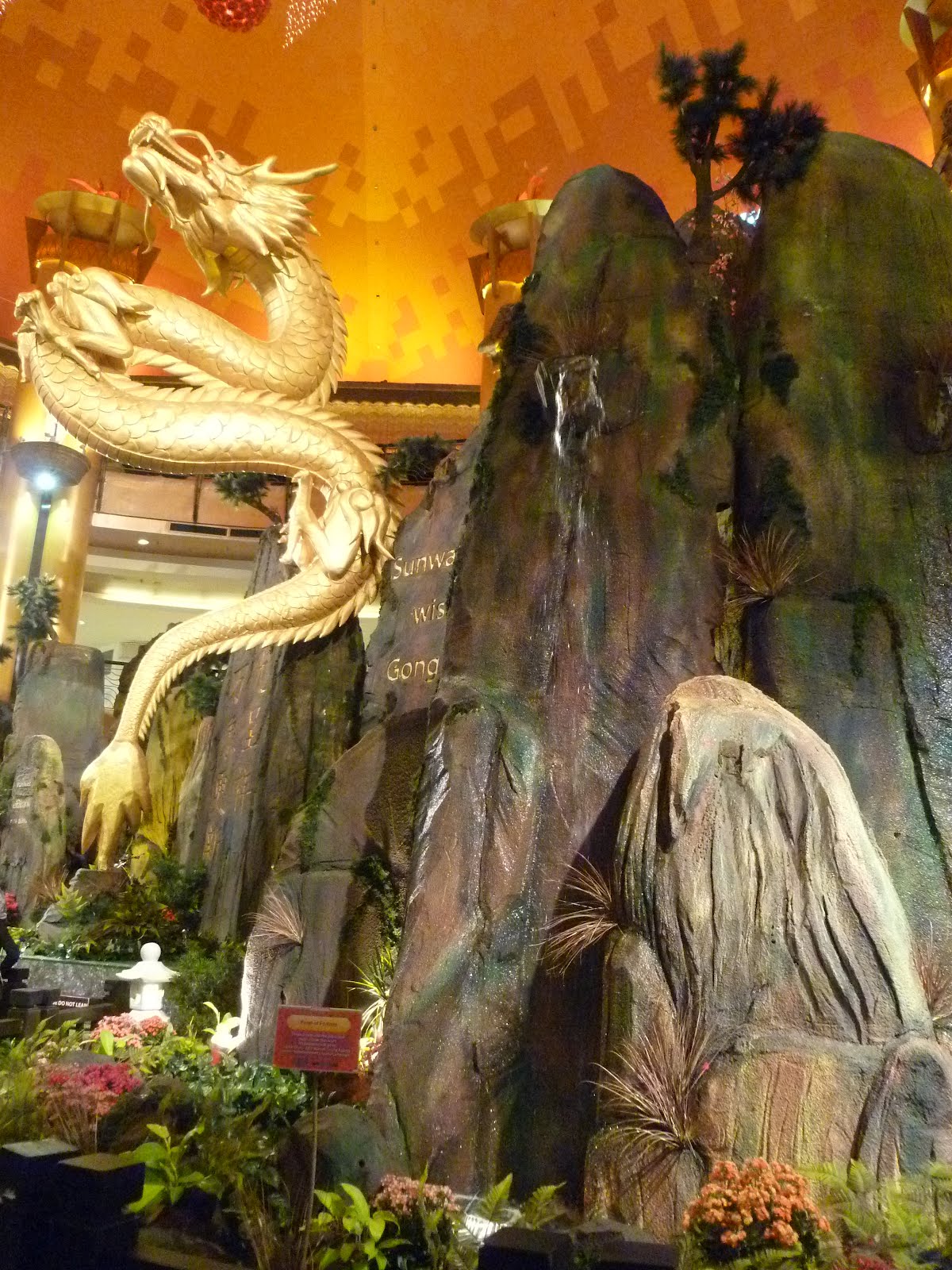
Shopping malls try to outdo one another in its decor to welcome in the Lunar New Year just as they did to celebrate Christmas. Many of them feature the Dragon as the Water Dragon makes its appearance this lunar new year.
Some other malls still use red lanterns.
Such decor help put people into the festive mood and there are many folks taking pictures of the dragon as well as the lovely settings.

To all people of Chinese origin who celebrate the Lunar New Year, Gong Xi Fa Cai!